Getting to Know Your Travel Partner Beforehand: 7 Proven Strategies

Reading time: 8 minutes
Imagine you book a two-week tour through Tuscany with a travel companion you only know from three WhatsApp messages. At the airport you realize: she talks nonstop while you need quiet. You love spontaneous detours, while she's glued to the guidebook. The vacation turns into a test of patience. That's exactly why it's crucial to get to know your travel partner beforehand, before you're sitting on the plane together with no way back.
According to a 2023 study by the German research association Forschungsgemeinschaft Urlaub und Reisen (FUR), 41 percent of German-speaking singles over 40 deliberately book their trips with a companion in order to share costs and intensify experiences. But only 23 percent meet their travel companion in person before departure. And that very pre-trip check decides between vacation joy and disaster.
Why in-person pre-trip meetings are indispensable
Text messages and phone calls convey at most 30 percent of a person's personality. That's what a 2022 University of Chicago study shows. Facial expressions, gestures, body language, and energy level stay hidden digitally. If you want to get to know your travel partner beforehand, you need at least one face-to-face meeting.
A concrete example: in 2023, Sarah from Chicago organized a study trip to Prague through a singles travel platform. After four weeks of exchanging emails, she met her potential companion Julia at a café in Lincoln Park. Within 20 minutes it turned out that Julia was a chain smoker and Sarah suffers from asthma. Sharing a hotel room would have been impossible. The pre-trip meeting spared both of them a stressful week.
Strategy 1: Local get-to-know-you meeting with an activity trial run
Arrange a first meeting in your city that simulates a mini version of your planned trip. Are you planning a hiking trip? Take a three-hour walk through the city park. Is a city trip through European Capitals of Culture coming up? Visit a museum together and test whether you have the same pace when strolling.
This method immediately shows whether the chemistry is right. You can tell whether the other person is punctual, how they handle waiting, and whether pauses in conversation get awkward. According to a 2023 analysis by the travel portal Urlaubspartner-gesucht.de, 67 percent of all travel partnerships fall apart because of differing pace preferences.
Concrete implementation with a checklist
Choose an activity that lasts at least two hours. Anything shorter isn't enough for honest impressions. Pay attention to the following points:
- Is the agreed meeting time kept, or do excuses come up?
- Does the person show initiative in decisions or always wait?
- How do they react to the unexpected (a closed café, a detour)?
- Does the energy level match, or do they need a break every 30 minutes?
- Do you share similar preferences on food, noise level, and crowds?
Strategy 2: A trial overnight stay before the big trip
Nothing tests compatibility better than a weekend together. Book an inexpensive hotel or vacation rental nearby and spend 48 hours together. Sounds like a lot of effort? It is, but it's far cheaper than a ruined $1,300 long-haul trip.
Mark from Seattle used this method in 2023 before a planned two-week tour through Portugal. With his potential travel partner Tom, he rented a vacation rental in Portland, Maine, for a long weekend. It turned out that Tom snores like a jackhammer at night and is wide awake at 6 a.m. Mark needs his eight hours of sleep. They decided on separate rooms for the Portugal trip, and in doing so saved the friendship.
Strategy 3: Digital pre-screening with a system
Before you meet someone in person, structure your digital getting-to-know-you phase. Instead of chatting randomly, hold three targeted video calls, each at a different time of day. Why? People behave differently in the morning than in the evening. You want to know how your travel partner ticks in a grumpy-morning mood, not just after the third coffee.
Ask concrete questions instead of generic platitudes. "What was your worst vacation moment?" reveals more than "Do you like to travel?" The platform travel partner apps recommends at least five hours of total conversation time before the first meeting.
Topic check for video calls
Clarify these core points in your pre-trip conversations: sleep rhythm (early bird or late sleeper?), food preferences (restaurant every evening or self-catering?), spending habits (penny-pincher or bon vivant?), alcohol consumption (a daily glass of wine or abstinent?), phone use (constantly online or digital detox?), conflict behavior (speaking directly or days of sulking?).
Strategy 4: Planning together as a litmus test
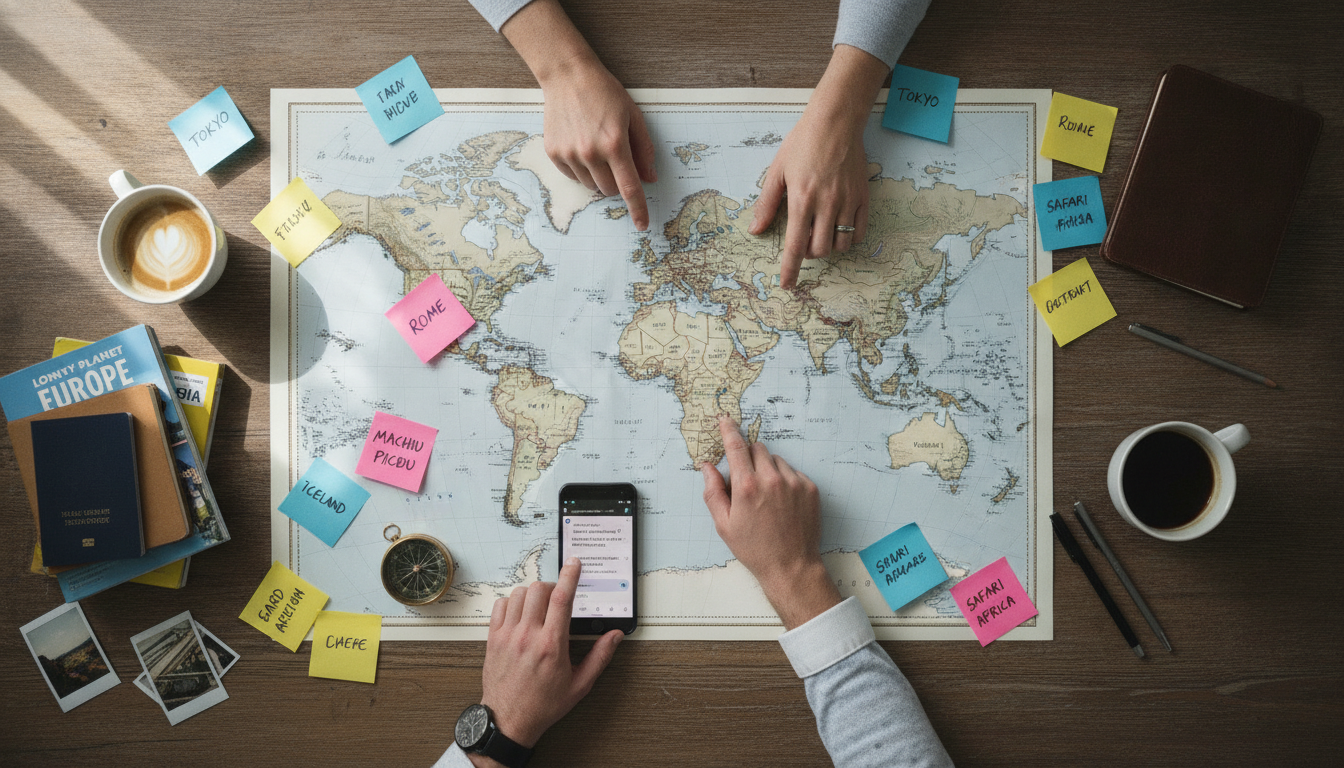
The way someone plans a trip reveals character traits. Together with your potential travel companion, organize a fictional day trip. Open Google Maps, choose a destination 60 miles away, and plan the route, stops, and mealtimes.
This exercise shows right away: is the person a detail planner or an improv fan? Do they want to structure every minute or say "let's see"? Both styles are legitimate, but they have to fit together. According to the German Travel Association, 54 percent of shared trips fail because of different planning mentalities.
Strategy 5: Getting references like in a job interview
It sounds formal, but it works: ask for contacts of former travel partners. Reputable people who have already traveled with others several times are happy to give two or three references. A short phone call with a travel companion from last year tells you what to look out for.
Andrea from Austin used this method in 2023 before a planned wine trip through Napa Valley. The reference from her potential travel partner warned her: "Petra is super organized, but she freaks out when trains are delayed." Andrea is extremely stress-resistant. They booked together anyway, but Andrea knew what to expect and could steer accordingly.
Strategy 6: Cost transparency from the start
Money is the most common point of conflict on trips. Clarify in writing before the first meeting: how will you split costs? Everything fifty-fifty or by actual use? Who books and pays up front? How do you settle up?
Create a shared Google Sheet with estimated expenses. Anyone who already reacts with annoyance to filling in a digital spreadsheet will lose it on vacation when collecting receipts. This simple test filters out incompatible money types before real money flows.
In 2023, the Verbraucherzentrale NRW (the consumer advice center of North Rhine-Westphalia) published a guide according to which 73 percent of all travel disputes among friends have financial causes. A clear cost plan up front prevents most of that.
Strategy 7: Agreeing on an exit without a guilty conscience
Even if you get along great, agree on a fair exit mechanism. Until when can each person cancel without financial consequences? What happens to services that are already booked and non-refundable? Clearing this up takes pressure off and shows how fairly and maturely the other person handles conflict.
Write a simple agreement: "Until March 15, 2025, either of us can back out without giving a reason. Shared costs already paid will be split in half, even in case of cancellation." Anyone who balks at this suggestion or reacts offended is probably not an ideal travel companion.
Typical warning signs when getting to know your travel partner beforehand

Some red flags show up already in the getting-to-know-you phase. Watch out for: constantly rescheduling meetings, vague answers to concrete questions, no social media presence (beware of fake profiles), pressuring you on booking decisions, asking for money up front.
In 2023, the portal Reisepartner-Vermittlung.de documented a total of 127 fraud cases in which fake travel partners collected deposits and then vanished into thin air. All the cases had one thing in common: the scammers refused to meet in person before booking.
Timeline: when should you get to know your travel partner beforehand?
Plan at least three months between first contact and departure. A realistic timeline: weeks 1-2 digital exchange, week 3 first in-person meeting, weeks 4-6 second meeting plus a shared activity, weeks 7-8 binding booking, weeks 9-12 detailed planning together.
This timeframe allows honest getting to know each other without pressure. Shorter periods lead to rash decisions, while longer ones let motivation fade.
Frequently asked questions (FAQ)
How do I tell at the first meeting whether the chemistry is right for traveling together?
Pay attention to your gut feeling after the meeting. Do you feel energized or drained? Are you looking forward to seeing them again or searching for excuses? Real compatibility shows in the fact that pauses in conversation aren't awkward and you make decisions at a similar speed. If after two hours together you feel you have to pretend or constantly compromise, it's not a fit.
What do I do if, after the pre-trip meeting, I realize we're not a match?
Address it directly and honestly, ideally within 24 hours. A polite but clear message saves both of you time and money: "I really enjoyed our meeting, but I notice that our travel styles are different. I want to be honest and would rather cancel now than later on vacation." Most people respect openness more than polite stalling.
Should I google potential travel partners or research them on social media?
Yes, definitely. Basic online research is part of due diligence. Check whether profiles are consistent, whether the person has a real social circle, and whether their online personality and real-life demeanor match. Be careful with profiles that have no history or contradictory information. That's not paranoia but reasonable caution when traveling with strangers.
How many pre-trip meetings make sense before traveling together?
A minimum of two in-person meetings in different situations. Three is ideal: a relaxed café meeting to get acquainted, a shared activity (hike, city stroll), and a longer time together that includes a meal. Only then do you have enough impressions about punctuality, conflict behavior, eating habits, and communication style. Anyone who wants to book after a single coffee underestimates the potential for conflict.
What does it cost to get to know a travel partner properly beforehand?
Expect $110 to $220 for pre-trip activities: café meetings, shared meals, possibly a trial overnight stay or a day trip. That sounds like a lot, but it's a fraction of what a failed joint trip costs. If you live in different cities, travel costs are added. Split these costs fairly or take turns organizing.
Conclusion: invest time, save your nerves
Getting to know a travel partner beforehand costs time, money, and effort. This investment pays off many times over. You avoid vacation disasters, protect your budget, and dramatically increase the chance of unforgettable shared experiences. The proven strategies, from the local activity check to trial overnight stays to reference checks, demonstrably work better than blind trust in digital profiles.
Start your travel partner search now and plan enough lead time. Use structured getting-to-know-you methods instead of spontaneous bookings. Your next vacation will thank you. You'll find more helpful tips for successful trips over 40 in our guides on successfully finding a travel partner and group trips for singles.